/
/

Reading Mode
Clean editorial style with drop caps, pull quotes, and refined typography
FIM, my filament inventory app, is now open to everyone. Track every spool and every gram, free for the whole Public Beta. Here's why I built it and how to join.
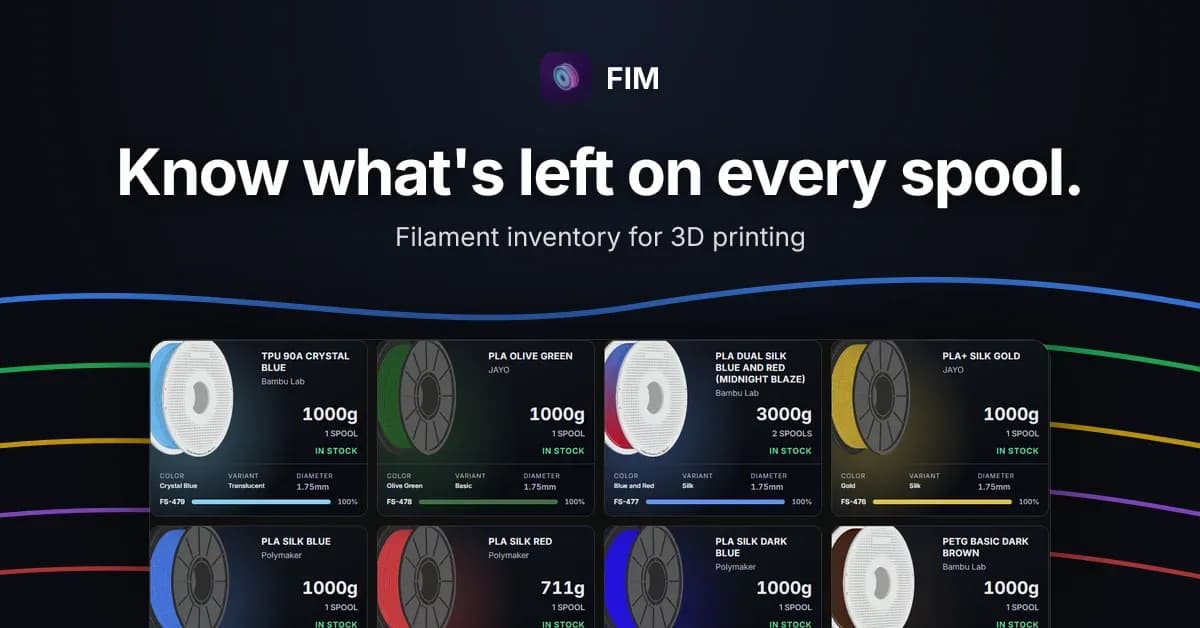
Every maker with more than a few spools knows it can be a pain to remember all the different filaments you have on hand or differentiating one from another just by looking at the colour in a print. Even within the same brand, judging by colour alone can be tricky.
For me, having over 400 spools across about 15 brands meant I not only had a lot to track, but a lot to try and remember as well. This was the primary reason I needed a better solution. Then along came my H2D with its Laser and Cutting modules, introducing even more materials I could use but also more to track.
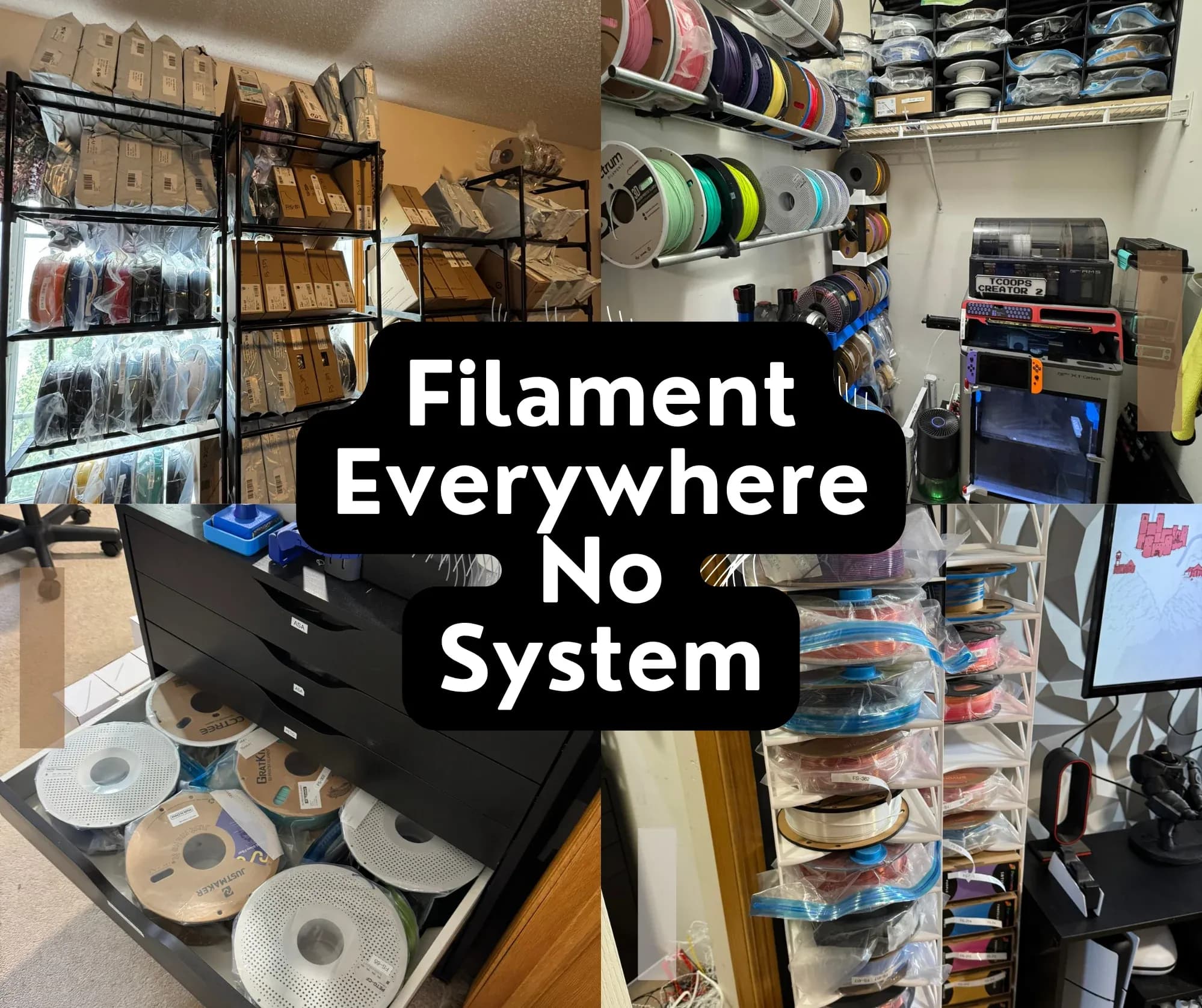
My filament collection grew the way most do: one good sale at a time plus a few "Oh I need to get that too!" moments. With all those spools feeding 5 Bambu Lab printers, I started tracking everything in a Notion database. Every filament got a short code like FS-235 so I could find it again. It worked, until it didn't. Notion could tell me what I owned and even what I used with a little Notion formula magic. What it couldn't do well was handle that data year over year or manage what project I used that filament for.
“I wanted an app that remembers the hard stuff, so I have more time to create. At the time, Notion just wasn't doing that for me.
So taking my 10+ years of development, UX, brand and marketing experience, I built the tool I wanted. FIM started as something just for my own shelves, but I realized others likely had the same problem I did, so I then started a closed beta that began around June of 2026. A small group of testers sent feedback, found bugs and asked for many of the features in it today.
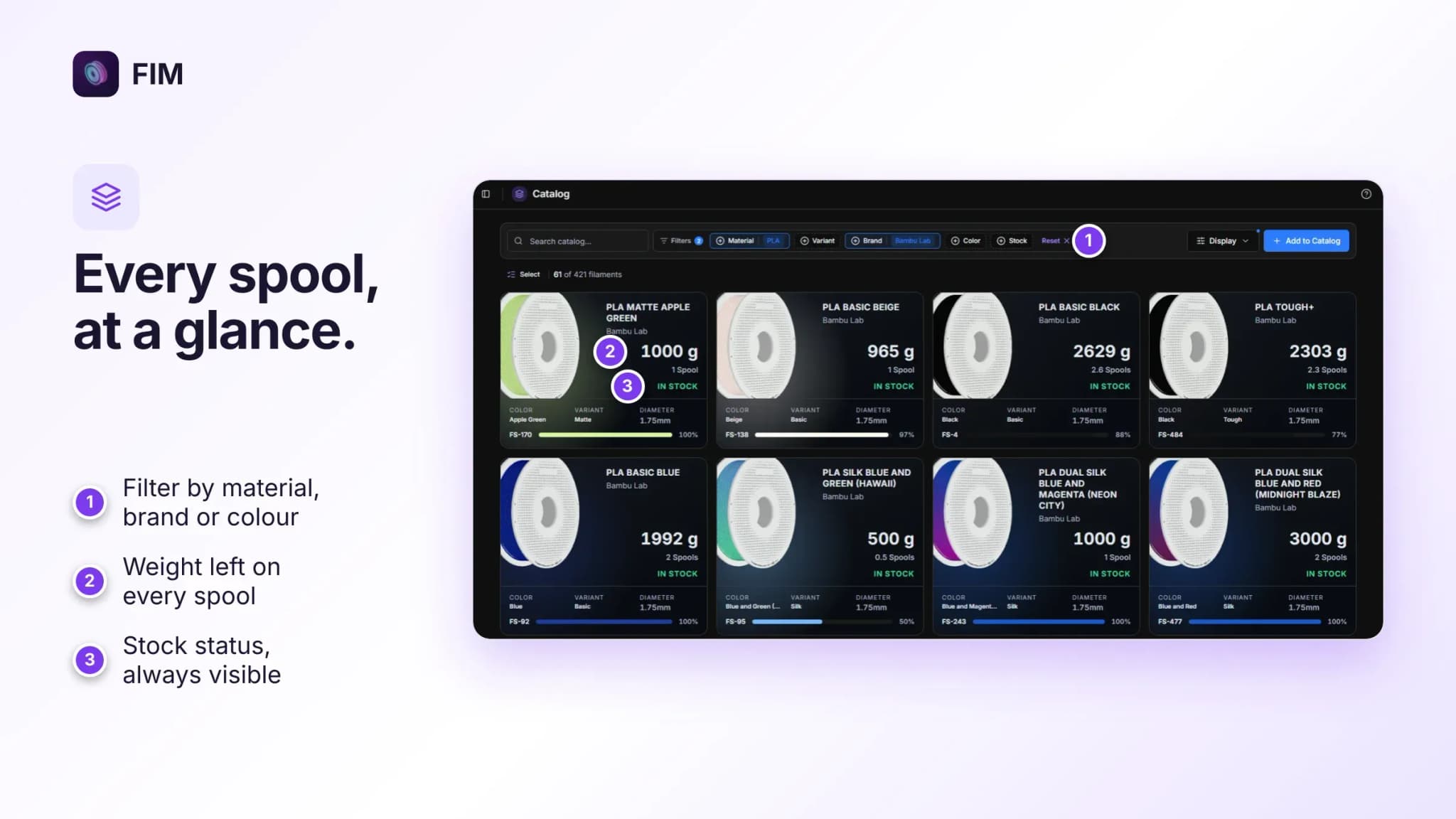
FIM at its core keeps your filament, the spools you own and every gram you use in one place. I made intentional decisions from the start to decouple your Catalog from your Inventory; a challenge I couldn't solve with Notion or other alternatives at the time.
You can count stock in grams or in spools, because not everyone wants to track spools so granularly. The UI lets you switch between light and dark themes and even install FIM as a desktop app so it's easy to access with no bookmarks or lost tabs. A guided tour with sample data shows you around before you add a single spool.
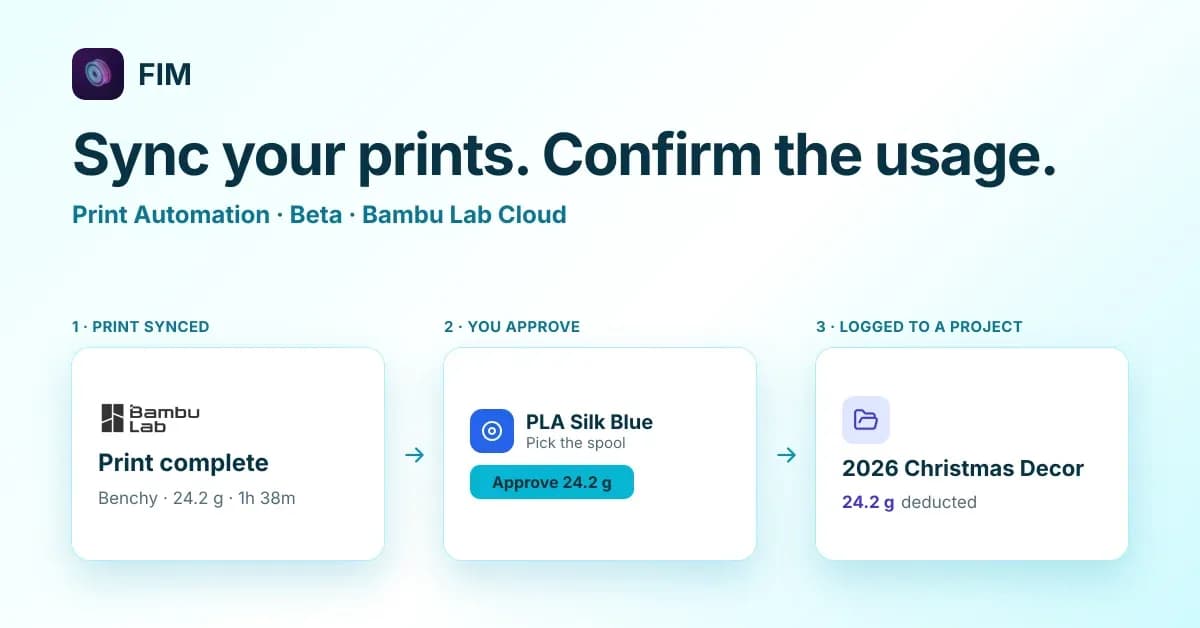
“💡 Got Bambu Lab printers? Print Automation lets you review finished Bambu Lab prints and deduct the filament they used from your inventory. It's free during the beta. Request access in Settings under Beta Features, and I review each request by hand.
Everything is free while the Public Beta runs, and it runs into 2027. After that, core tracking stays free (yes, I mean it), while a few advanced features move to a paid plan. Pricing hasn't been set yet but the feature set has:
The most important part of the beta: your data is never deleted. If a paid feature locks after the beta, everything you saved in it stays in your account, and you'll get 30 days' notice by email and in the app before anything changes.
A beta phase is important because FIM is still growing, and the people using it help decide where it goes. You can report a problem or suggest a feature from inside the app, and every user gets 10 votes to use on the Roadmap so YOU decide what gets built next. The roadmap shows what's planned, and every release lands on the updates page so you can see what changed and when.
Oh, and did I mention that active participants during the beta may also receive upgrade benefits when paid plans arrive? Those aren't announced or guaranteed for every user, but if you use FIM and tell me what's working and what isn't, you're exactly who I'm building it for.
“📣 Ready to find out how much filament you really have? Join the FIM Public Beta. It's free, it takes a couple of minutes, and your shelves will thank you.
Happy printing, Tyler Cooper (TCoops)
After losing track of 380+ filament spools across multiple printers, I built FIM — a cloud-based inventory manager designed to make filament tracking fast, accurate, and actually usable. This post shares the problem, the process, and what I learned while turning a personal frustration into a real tool.