/
/

Reading Mode
Clean editorial style with drop caps, pull quotes, and refined typography
After losing track of 380+ filament spools across multiple printers, I built FIM — a cloud-based inventory manager designed to make filament tracking fast, accurate, and actually usable. This post shares the problem, the process, and what I learned while turning a personal frustration into a real tool.
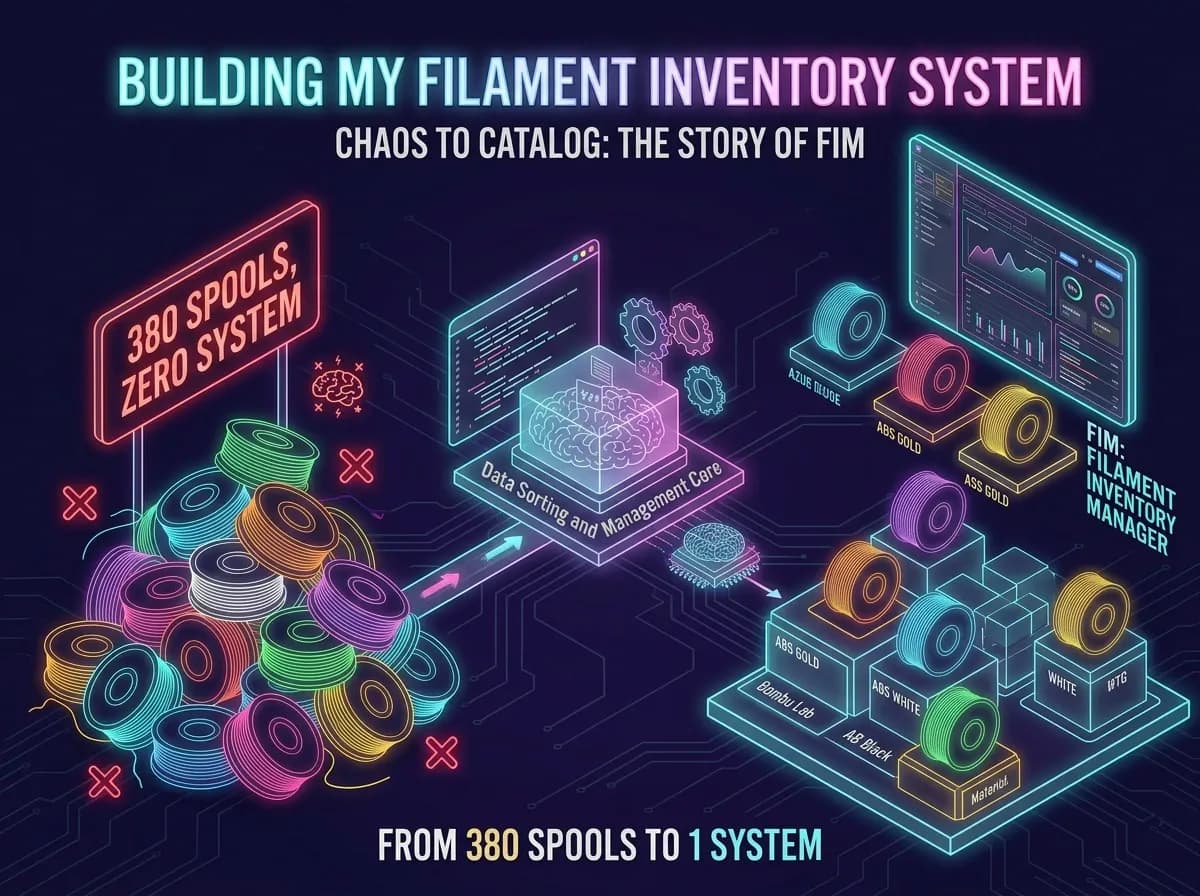
Filament piling up and only a Notion database to manage it and filing taxes became difficult with no inventory tracking. Nothing in the market felt it hit what I needed and wanted in an app. FIM was the solution I created to manage your filament.
I have over 380 spools of filament. Across five Bambu Lab printers — one H2D with dual AMS, two X1C machines, an A1 Mini, and an A1. I've spent somewhere between $7,000 and $10,000 on filament over the past few years. It covers most of one wall in my workspace.

And for the longest time, I tracked all of it in my head.
Not even a spreadsheet. Just vibes. An approximate sense of "yeah I have some blue PETG somewhere" that turned out to be wildly inaccurate more often than I'd like to admit.
There's a specific kind of frustration that comes from mid-print spool runout. You start a four-hour print, you walk away, you come back expecting a finished piece, and instead you find a half-printed object and a very empty spool sitting next to it.
That happened to me more than once. More than twice. Enough times that I started logging it — which is its own kind of irony, given that the whole problem was I wasn't logging anything.
Beyond the failed prints, there was the buying problem. I'd order filament and then discover I already had two spools of the same color in the same material from a different purchase I'd forgotten about. PLA was the worst offender. I had at least five full spools of the same brand-name Galaxy Black PLA at one point. Five. Because I thinking "I probably need more of that." while buying other filaments.
While I am usually the person who jumps right to "I should build this" immediately, this time I felt it was simpler to do it manually or with Notion.
A spreadsheet — Obviously. Everyone tries the spreadsheet. The spreadsheet is the "I should eat healthier" of maker organization — theoretically correct, practically abandoned by week three.
Notion — I used Notion database first. It worked for about a year before it really became an issue with trying to automate it and track multiple years. But one of the bigger problem was the friction of actually maintaining it. Logging a spool in Notion requires clicking through a few levels of navigation, opening a database, entering values in multiple fields.... it's not complicated, but it's just enough friction that it breaks down. I'd log spools when I was organized and skip it when I was in the middle of a print session, and pretty quickly the database was accurate for about 40% of my inventory and useless for the rest.
There's a point where frustration turns into clarity. Mine came during a weekend where I was printing a set of orders for TCoops Create, I ran out of a specific PLA Pro from Polymaker mid-way through my massive Lego-inspired Christmas tree and when I went to grab another spool, I found out I'd used the last one and hadn't noted it.
I spent forty-five minutes hunting through my shelves and then looking to order filament but it was out of stock!!
That's when I opened a new project in Emergent AI to kickoff the build of a full-stack web app as a base for my work.
Not because I thought I could build something better than everything that existed. But because I knew exactly what I needed, and nothing I'd tried quite fit. I needed something cloud-based so it worked on any device without a server setup. I needed it to handle the full range of materials I work with — not just PLA and PETG, but ASA, ABS, TPU, Nylon, PC, all of it. I needed low-stock alerts that fired before I ran out, not after. And I needed it to be fast to update — five-second logging, not five-minute workflows.
I want to describe this honestly, not like a product page.
Start with the real workflow and constraints; only add complexity when it directly solves a pain point.
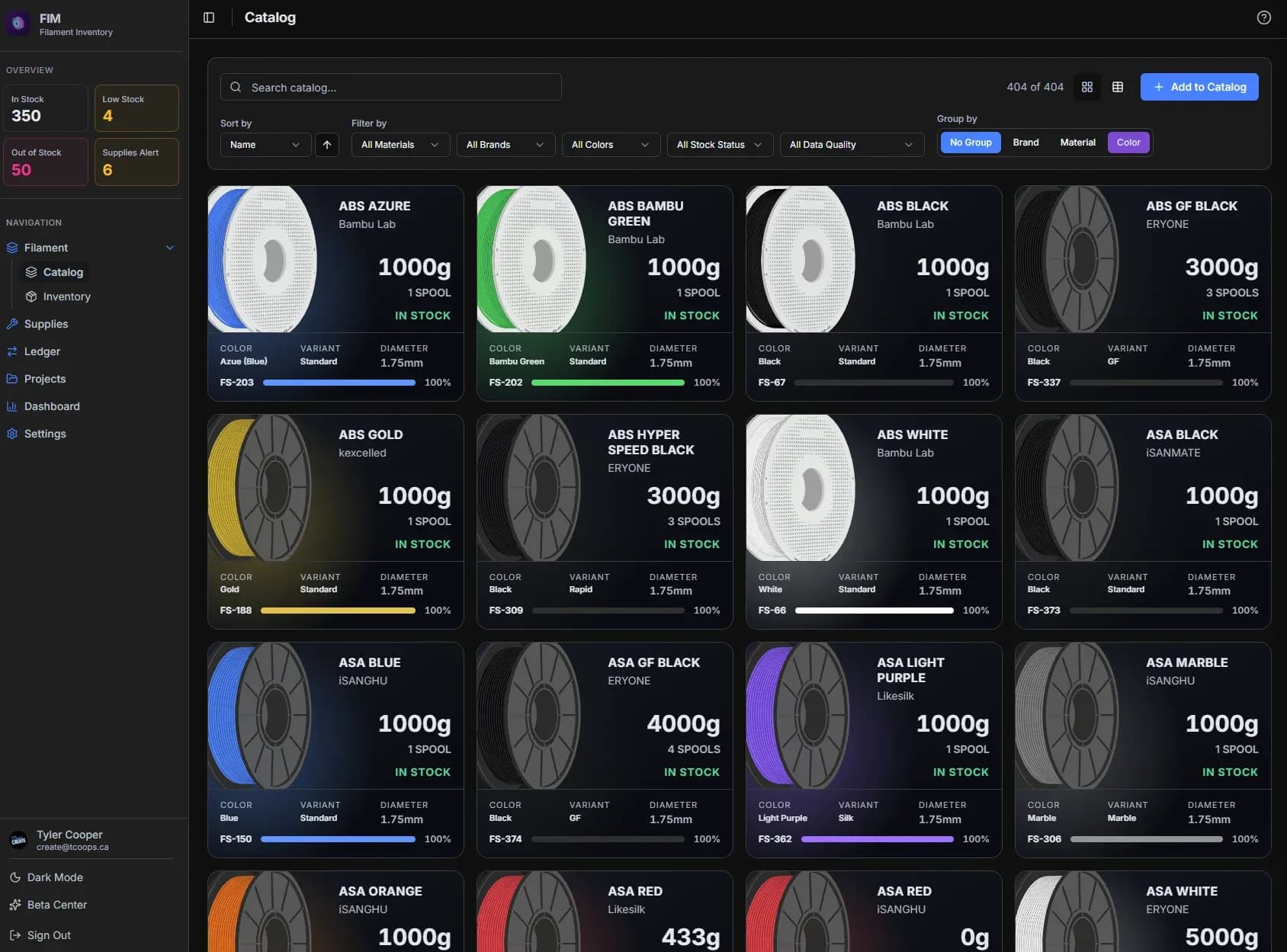
FIM tracks filaments in your catalog and spools in your inventory. They are separate concepts and that took me some time to figure out and posed a design and UX challenge.
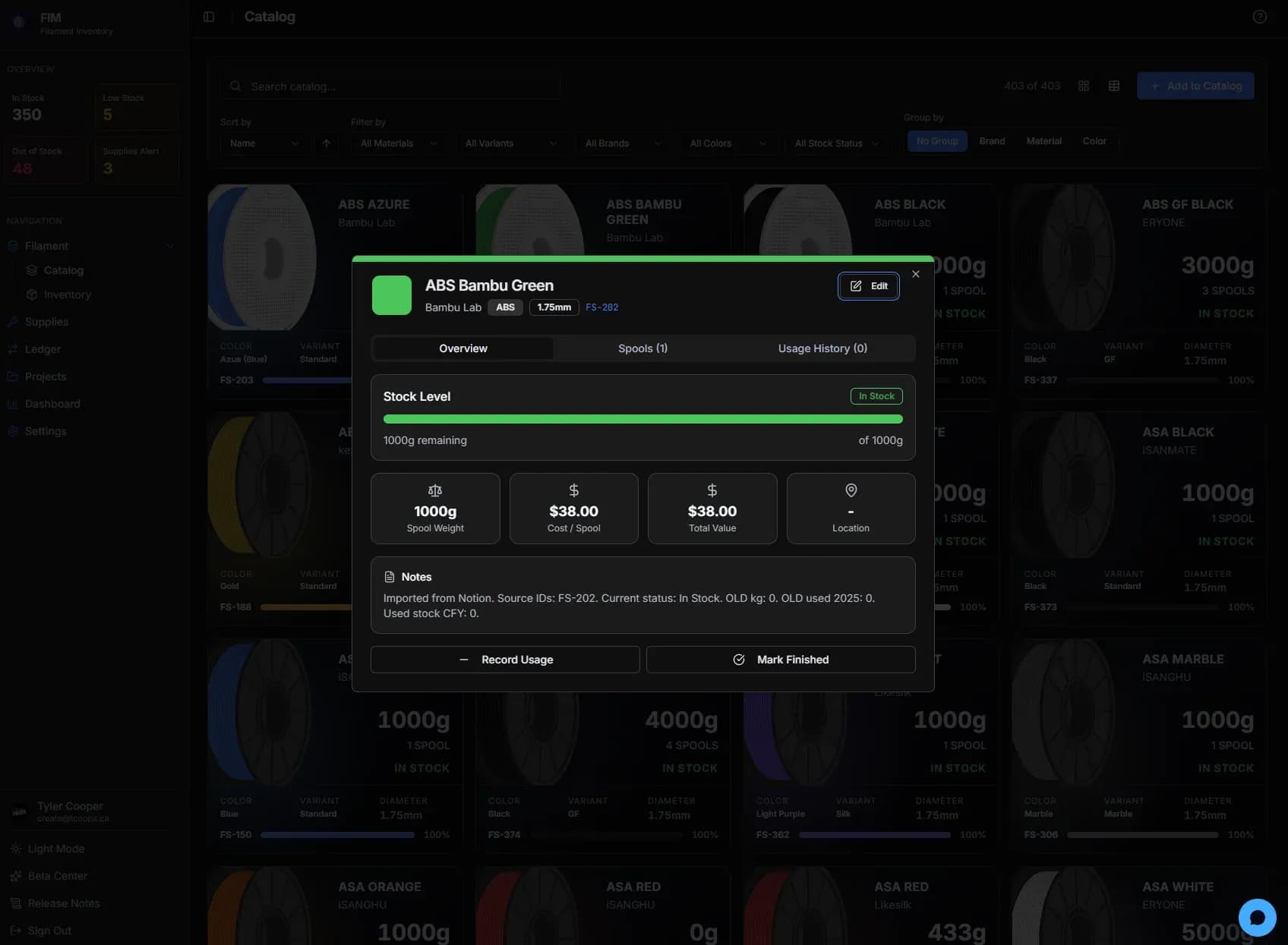
That's the core of it. Everything else is built on that foundation. The concepts and features below give a clearer picture of why FIM is different from the other great options in the market.
What it doesn't do yet: direct Bambu Studio integration (that's on the roadmap) meaning near-automatic weight updates from your printer (a much harder problem I'm actively thinking about) as well as enriching catalog filaments with data points from the community of printers shared through tools like SpoolmanDB. I'm building this as a solo developer, running it as a real business alongside TCoops Create and my consulting work. That means the roadmap is honest — it reflects what I can actually build, not what sounds impressive in a pitch deck.
FIM is in a curated beta. That phrasing matters — it's not a standard waitlist where you add your email and eventually get in. It's an application. I'm reviewing each one and selecting beta users who I think can give meaningful feedback on real use cases. This allows me to get close to the users, hear their thoughts and ideas then action on them to build a better experience backed by user feedback, not just what I think is needed.
I'm specifically looking for a mix of people so that FIM is saleable for anyone using it.
The tool needs to work across that range, and I need feedback from each segment. The beta is free. Beta users get full access to the current feature set and direct input on what gets built next.
Building a tool you actually use changes how you build it. Every time FIM frustrates me, I note it and either fix it or add it to the backlog. Every decision is informed by what it's like to have 380 spools and five printers and a real production workflow.
But I've also learned that my use case isn't universal. Some beta applicants have one printer and 15 spools. The tool needs to serve them without feeling like it was designed for someone with a warehouse. That UX tension — powerful enough for my setup, approachable for a hobbyist — is the hardest thing I'm working on right now.
The thing I keep coming back to is this: the goal isn't to replace your brain. It's to offload the part of your brain that's keeping track of 380 spools so you can use that capacity for the actual creative and problem-solving work that makes 3D printing interesting.
The beta will run for another few months before I move toward a public launch. If you want to get in before that happens, you can apply at filamentinventorymanager.com. Tell me about your setup — how many printers, roughly how many spools, what you're currently using to track (including "nothing") — and I'll be in touch.
If the beta is full by the time you're reading this, the waitlist is there too. I'll keep you posted on launch timing and give waitlist members early access to the free tier.
And if you have questions — about the tool, about the build process, about any of the decisions I've made — hit me up. I'm genuinely reachable, I respond to emails, and I like talking through this stuff.
Tyler Cooper is a digital product builder and creative tech entrepreneur based in Calgary, Alberta. He runs TCoops Create and is building FIM alongside his other projects.
One Year, 500+ Parts and a Lot of Filament! Follow my year-long journey printing a massive LEGO-inspired Christmas tree across 5 Bambu Lab printers. See the challenges, the hiccups, and what I learned along the way.
Explore the fundamentals of 3D printing, updated for 2026. Learn about FDM printing, materials, costs, and where to find 3D models in this comprehensive beginner's guide.